
Personal
Growth
A continuous, active journey of self-discovery.
Our pleasure, purpose, and goal are to share Connection - Holistic Lifestyle - Alternative Healing Treatments - Living Happier with New Thought - from original sources.
GlobalCnet links to the original thought, research, new ideas, and found expert advice. We have assembled extensive information and facts to inspire YOU to further your education, skills, and desires in your specific subjects. When you click on a blue link, you arrive at a website, do your research, and observe all the other articles available to you. Record what you need. Share what you learned
GlobalCnet connected you to make better-informed decisions.
This is a teaching and informative Web Site again, presenting original authors, like Harvard University, MedNet, Unstuck.com, Readers Digest, Mental Health, and documents from millions of Web Sites that were written, published, and illustrated with specific content to expand your knowledge for personal growth, health, and answers. All this WWW content was meant for your reading and answers,
GlobalCnet just connected you.
We hope you use all information for further answerers, ideas for more exploration, and the wisdom to share discoveries with others. It is all about having the right fast or safe connections. Everything has already been discovered, be smart, use proven methods and spin your solutions to fit your needs.
If you have any questions, comments, or to just say hello...leave webmail.
Quick links to information and new ideas. click here.
OK...you are now on GlobalCnet. You can use the SEARCH BAR to find subject information quickly, or all the pages. Your visit will award an organized starting point leading to answers to your challenge.......just do it. Type in a word and hit search.
- Michael J. Malette, PhD
Founder, Global Connection Networks, Inc.
What is Personal Growth?
Personal growth is a continuous journey of self-discovery and improvement.
It can involve developing one’s capabilities, gaining new skills, learning how one fits into the world around one, and enhancing one’s understanding of oneself.
Through personal growth, individuals expand their capabilities, enrich their relationships, and create more meaningful careers and lives.
This transformative process touches all areas of life: personal, interpersonal, and professional.
If you want to learn more about personal growth and how it can enhance your life, keep reading this blog as delves into the importance of self-development!
Why Is Personal Growth Important?
Personal growth is essential to living a fulfilling life and contributes to our well-being and happiness. Embracing lifelong personal development is crucial for achieving success and fostering deeper life satisfaction.
Some benefits of prioritizing personal growth are increased self-awareness, improved intrapersonal relationships, career advancement, and a greater sense of fulfillment.
Personal growth starts with self-awareness.
By understanding your strengths and weaknesses, you can gain clarity about what drives you and hinders your advancement.
This self-knowledge allows you to make decisions that will help you be the best version of yourself.
As you develop your unique sense of self, you will also begin to forge meaningful connections with those around you whose ideals align with yours.
Personal growth helps you develop soft skills such as empathy, communication, conflict resolution, and emotion management, which can strengthen your relationships with others.
Personal development and career advancement go hand in hand for many professionals.
As you gain new skills and self-awareness, you might also find yourself on the path to professional growth.
Overall, personal growth can lead to a sense of fulfillment in your life.
By continuously striving to become a better version of yourself, you gain confidence and feelings of achievement.
This ongoing journey of self-improvement contributes to a deeper understanding of yourself and the world around you.
How to Create a Personal Growth Plan
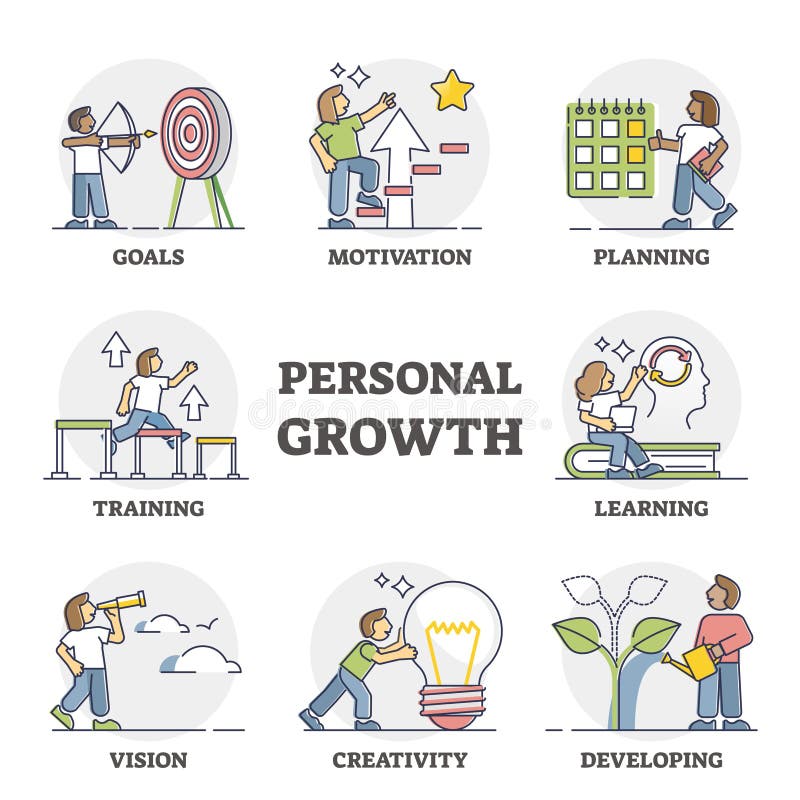
While personal development strategies can vary from person to person, the six activities below can help facilitate growth, guide you toward your developmental goals, and create a personal growth plan.
1. Setting SMART Goals
Specific, Measurable, Achievable, Relevant, and Time-bound (SMART) goals provide a structured approach to personal development by breaking down a large objective into manageable steps.
2. Reading and Learning
Expanding your knowledge through reading and learning can facilitate personal growth.
Whether it’s self-help books, biographies, or online courses, exposing yourself to new ideas and perspectives can foster intellectual and emotional development.
3. Journaling
By regularly writing about your thoughts, feelings, and experiences, you can gain valuable insights into your behavior and motivations.
This practice can help you track your progress and identify areas for improvement.
4. Seeking Feedback
Constructive criticism is essential for personal growth, so seeking feedback from mentors, colleagues, or friends can help you gain different perspectives on your performance and areas for improvement.
5. Participating in Workshops
Workshops and seminars are an excellent way to forge connections with those who share your interests.
Attend events related to your interests or career goals to gain new skills and network with like-minded individuals.
6. Practicing Mindfulness
Practicing mindfulness helps cultivate self-awareness and emotional regulation.
By incorporating mindfulness into your daily routine, you can better understand your thoughts and feelings, improving stress management and overall well-being.
The Joy of Personal Growth
Openness, balance, engagement, and determination.
Key points
- Always be on the lookout for opportunities to learn about yourself.
- Joy can emerge from experiencing personal growth and learning about yourself.
- People able to grow and develop are more creative in their approach to life and its obstacles.

Many psychologists have speculated on what it means to live a good life.
Studies have proposed different ways of measuring happiness and well-being.
Some focus on enjoyment and pleasure, while others are centered on meaning and purpose, relationships and belonging—a combination of these or some other concepts.
There is no one agreed-upon definition of what it means to be happy.
Does that mean that each person should decide for themselves what it takes to lead a good life?
I agree that each person should have that freedom.
Yet at the same time, I would argue that there is a deeper similarity that emerges across people when they are more fully developed emotionally and personally, which is often overlooked: the joy and wonderment that emerges from experiencing personal growth and learning.
This is something one often sees in therapy clients as people get to know themselves better.
They come to understand the tricks of self-deception they have been playing on themselves and become comfortable acknowledging their strengths and failures.
They begin to take an active interest in learning about themselves.
They become more content with who they are while also striving to be more than they are.
They are curious about themselves and the new possibilities ahead.
They take joy in learning about themselves.
This is something that has become ever more important to me, and that I now see as one of the most fundamental aspects of "the good life."
It is a process that is common in all truly happy people.
It is also unique: In many of the "typical" ways of thinking about the good life, we see ourselves as passive receivers of happiness, but this is much more active and about the effort we put in.
By developing ourselves in this way, we become someone who can treat events in our lives as learning opportunities.
Such people do not feel that they are in competition with others and always must try to prove themselves.
When they meet new people, they are interested in them and what they have to say, and do not feel the need to score points or try to be cleverer than others; instead, they're open to learning from them.
These are not simply people who are adjusted to their culture, but who can live within it, often harmoniously.
But they do not conform. They will seek to balance their own needs for autonomy in a socially constructive way that takes into consideration the needs of others. Such people will be more determined to do their own thing, whatever it is that is right for them, but not in a way that tramples over others.
And they will not bend easily to others who want to trample over them.
Such people are also more creative in the sense of how they approach life.
They can see new patterns and different options for navigating obstacles.
They drop their defences, become more able to think about whatever is troubling them, and look at things from new perspectives.
This is an active process, one that requires engagement, commitment to development, and a willingness to be challenged by confrontations with reality.
To be truly honest with ourselves means letting go of the stories we tell ourselves—the comforting narratives that bolster our self-esteem—and diving deep into the choppy waters of self-knowledge.
That can be the hardest part.
Before we experience the joys of personal growth, we often must overcome the fear of it.
But once that process has started—we have committed ourselves, decided that reality is better than fiction, and begun to experience true personal growth—it is hard to turn back.
Personal growth means leaving ourselves behind to find ourselves.
Ask yourself: Does any of that sound familiar?
Have you taken delight in learning something about yourself that showed you that you had been previously deceiving yourself, wrong in your views, or misguided in your opinions?
Have you experienced the joy of personal growth?
Always be on the lookout for opportunities to learn about yourself.
This is an adapted extract from my book
Joseph, S. (2002). Think Like a Therapist: Six Life-Changing Insights for Leading a Good Life. Piatkus/Little, Brown. London.

5 Areas of Personal Growth(Plus Tips for Development)
From the Indeed Team

- Understanding personal growth and how you can achieve it can help you effectively utilize your skills in the workplace and advance professionally.
- Performing simple tasks, such as staying informed about trends and updates in your field, can help you experience gradual mental growth that can lead to increased productivity at work.
- Identifying the most appropriate personal growth methods for you depends on your strengths, challenges and goals.
Personal growth is a lifelong journey of self-improvement and development.
It is important in many aspects of life, including your career.
Identifying the most appropriate personal growth methods for you depends on your strengths, challenges and goals.
Understanding personal growth and how you can achieve it can help you effectively utilize your skills in the workplace and advance professionally.In this article, we list five areas of personal growth, discuss why it's important to understand areas of personal growth and offer tips to support your personal development.
5 areas of personal growth
Here are the five areas of personal growth and what they involve:
1. Mental growth
Mental growth focuses on the development of your mind, such as how you think and learn.
It also relates to how your cognitive functions affect your behavior. Improving mental aptitude can benefit anyone, especially in the workplace.
Performing simple tasks, such as staying informed about trends and updates in your field, can help you experience gradual mental growth that can lead to increased productivity at work.
Related: How To Request Mental Health Days
2. Social growth
Social growth involves improving your communication skills.
While some professionals focus on developing other skills, learning how to communicate effectively can be crucial, especially if you work independently.
Learning how to become an active listener and a clear speaker can help you work more productively within a team, offer insight in meetings and give feedback to your supervisors about your job.
It can also help you develop friendships at work that promote job satisfaction.
Related: 10 Ways To Develop and Improve Your Social Skills
3. Spiritual growth
Spiritual growth refers to connecting with yourself on a holistic level, developing as a person, and finding inner peace.
People can experience spiritual growth in various ways depending on their culture, beliefs and experiences.
Some prefer a structured approach to spiritual growth, such as practicing a religion or meditating regularly, while others work on improving their spiritual health as they feel they need it.
Spiritual growth can be important in the context of work because it can help you manage stress and build confidence in yourself and your abilities.
Related: 18 Ways To Achieve Self-Growth
4. Emotional growth
Emotional growth focuses on the development and management of your feelings and how you react to situations.
While challenges such as stress and anxiety can contribute to burnout, emotional growth can help you overcome those challenges.
This can assist you in expressing your emotions effectively and discussing your opinions with patience and open-mindedness.
Emotional growth allows you to process and evaluate your feelings at work, which can help you choose an appropriate course of action.
When teams practice emotional growth habits, they can minimize conflict among colleagues.
Related: How To Improve Emotional Intelligence in 9 Steps
5. Physical growth
Physical growth involves taking care of your body and using it productively.
Your physical condition affects all other areas of personal growth and development, as a healthy body facilitates effective brain functioning.
You can focus on physical growth by eating nutritious meals, exercising regularly and getting adequate sleep.
When you feel better physically, you may find it easier to work more efficiently.
Related: 12 Wellness Tips for the Workplace To Improve Your Health

<< New text box >>








 Print
