
Mindfullness.
It is our pleasure, purpose, and goal to share Connection - Holistic Lifestyle - Alternative Healing Treatments - Living Happier with New Thought - from original sources.
GlobalCnet is a collection of links to original thought, research, new ideas, and expert advice. We have assembled extensive information and facts to inspire YOU to further your education, skills, and desires in your specific subjects. When you click on a blue link, you arrive at a website, do your research, and observe all the other articles available to you. Record what you need. Share what you learned
GlobalCnet connected you, to make better informed decisions.
This is a teaching and informative Website again, presenting original authors, like Harvard University, MedNet, Unstuck.com, Readers Digest, Mental Health, and documents from millions of websites that were written, published, and illustrated with specific content to expand your knowledge for personal growth, health, and answers. All this WWW content was meant for your reading and answers,
GlobalCnet just connected you.
It is our hope that you use all information for further answers, ideas for more exploration, and the wisdom to share discoveries with others. It is all about having the right fast or safe connections. Everything has already been discovered, be smart use proven methods, and spin your solutions to fit your needs.
Any questions, comments or to just say hello...leave a webmail .
Quick links to information and new ideas. click here.
OK...you are now on GlobalCnet. You can use the SEARCH BAR to quickly find subject information, or you can visit all the pages. Your visit will award an organized starting point leading to answers to your challenge.......just do it. Type in a word and hit search.
- Michael J. Malette, PhD
Founder, Global Connection Network, Inc.
How to Practice Mindfulness
Becoming more aware of where you are and what you’re doing, without becoming overly reactive or overwhelmed by what’s going on around you.

Mindfulness is a natural quality that we all have. It’s available to us in every moment if we take the time to appreciate it.
When we practice mindfulness, we’re practicing the art of creating space for ourselves—space to think, space to breathe, space between ourselves and our reactions.
When we practice mindfulness, we’re practicing the art of creating space for ourselves—space to think, space to breathe, space between ourselves and our reactions.
What You Need to Know Before Practicing Mindfulness:
- You don’t need to buy anything. You can practice anywhere, there’s no need to go out and buy a special cushion or bench—all you need is to devote a little time and space to accessing your mindfulness skills every day.
- There’s no way to quiet your mind. That’s not the goal here. There’s no bliss state or otherworldly communion. All you’re trying to do is pay attention to the present moment, without judgment. Sounds easy, right?
- Your mind will wander. As you practice paying attention to what’s going on in your body and mind at the present moment, you’ll find that many thoughts arise. Your mind might drift to something that happened yesterday, meander to your to-do list—your mind will try to be anywhere but where you are. But the wandering mind isn’t something to fear, it’s part of human nature and it provides the magic moment for the essential piece of mindfulness practice—the piece that researchers believe leads to healthier, more agile brains: the moment when you recognize that your mind has wandered. Because if you can notice that your mind has wandered, then you can consciously bring it back to the present moment. The more you do this, the more likely you are to be able to do it again and again. And that beats walking around on autopilot any day (ie: getting to your destination without remembering the drive, finding yourself with your hand in the bottom of a chip bag you only meant to snack a little from, etc.).
- Your judgy brain will try to take over. The second part of the puzzle is the “without judgment” part. We’re all guilty of listening to the critic in our heads a little more than we should. (That critic has saved us from disaster quite a few times.) But, when we practice investigating our judgments and diffusing them, we can learn to choose how we look at things and react to them. When you practice mindfulness, try not to judge yourself for whatever thoughts pop up. Notice judgments arise, make a mental note of them (some people label them “thinking”), and let them pass, recognizing the sensations they might leave in your body, and letting those pass as well.
- It’s all about returning your attention again and again to the present moment. It seems like our minds are wired to get carried away in thought. That’s why mindfulness is the practice of returning, again and again, to the breath. We use the sensation of the breath as an anchor to the present moment. And every time we return to the breath, we reinforce our ability to do it again. Call it a bicep curl for your brain.
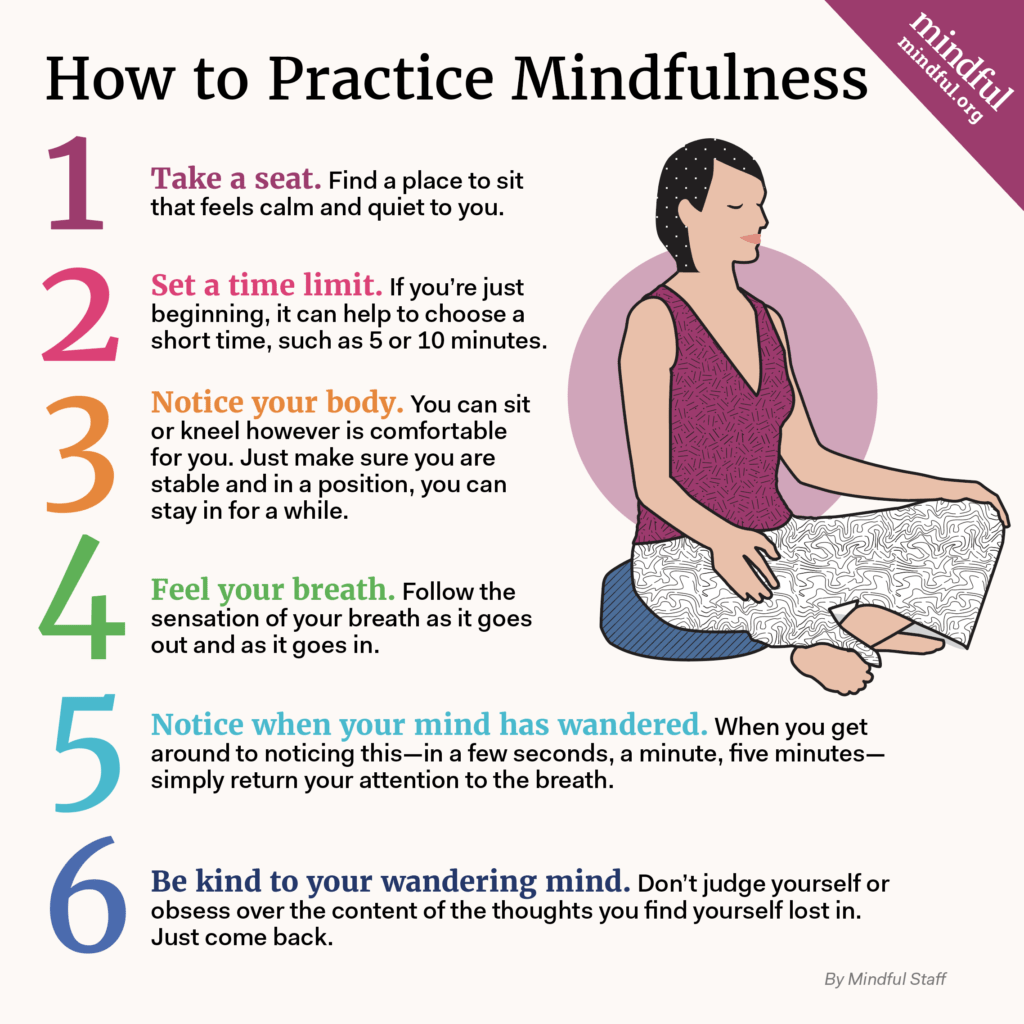
How to Practice Mindfulness
While mindfulness might seem simple, it’s not necessarily all that easy. The real work is to make time every day to just keep doing it. Here’s a short practice to get you started:
- Take a seat. Find a place to sit that feels calm and quiet to you.
- Set a time limit. If you’re just beginning, it can help to choose a short time, such as 5 or 10 minutes.
- Notice your body. You can sit in a chair with your feet on the floor, you can sit loosely cross-legged, in lotus posture, you can kneel—all are fine. Just make sure you are stable and in a position you can stay in for a while.
- Feel your breath. Follow the sensation of your breath as it goes out and as it goes in.
- Notice when your mind has wandered. Inevitably, your attention will leave the sensations of the breath and wander to other places. When you get around to noticing this—in a few seconds, a minute, five minutes—simply return your attention to the breath.
- Be kind to your wandering mind. Don’t judge yourself or obsess over the content of the thoughts you find yourself lost in. Just come back.
That’s it! That’s the practice. You go away, you come back, and you try to do it as kindly as possible.
About The Author

Mindful Staff
Our Mindful.org editorial team specializes in mindfulness, meditation, and mindful living content for Mindful magazine and Mindful.org. We research, write, and curate evidence-based insights, guided meditations, and practical tips designed to boost well-being, reduce stress, and nurture a daily mindfulness practice. Count on our expert editors to deliver the latest mindfulness news, meditation techniques, and mindful living strategies to help you live more present, balanced, and resilient.








 Print

